|

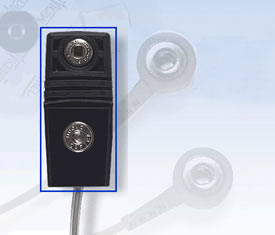
Sensor construction
'Sensor construction' is defined as: the (mechanical) construction
which is used to integrate the electrodes, the cables and
(if applicable) the pre-amplifier. It is expected that the
construction (and its mass) do not directly effect the SEMG
characteristics. There are nevertheless some potential indirect
effects which can disturb or interfere with the recorded SEMG
pattern:
- if the construction of the sensor is such that IED can vary
during muscle contraction this will modulate the amplitude,
shape and width of the action potentials and will consequently
affect the interference pattern both with respect to its amplitude
and frequency characteristics.
-if the construction of the sensor is such that electrodes
and cables can move, there is the potential risk for movement
artefacts (due to pulling of cables or inertia of the construction).
SENIAM recommendations
for sensor construction
The SENIAM recommendations for sensors restrict to bipolar
sensors only. 'Sensor construction' is defined as: the (mechanical)
construction which is used to integrate the electrodes, the
cables and (if applicable) the pre-amplifier.
SENIAM recommends a construction with fixed inter electrode
distance, built from light weight material. Cables need to
be fixed using (double sided) tape or elastic band in such
a manner that pulling artefacts can be avoided.
If in fast dynamic contractions the sensor construction causes
too much (movement) artefacts (due to inertia of the construction),
SENIAM recommends to fix the inter electrode distance using
(double sided) tape or rings.
|